|
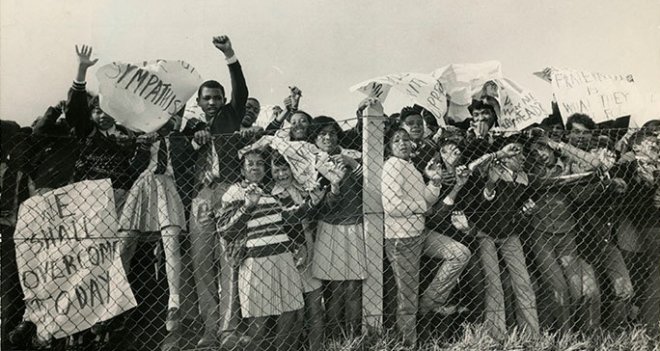
By 1974, the government intensified its oppressive policies by issuing a decree making Afrikaans (the language of the oppressor), compulsory as a medium of instruction in half the subjects taught in black schools, including mathematics and social science. This policy was met with fierce resistance. Afrikaans was viewed not only as an unwelcome foreign language but also as a symbol of the oppressive regime, deliberately intended to further marginalise and disempower black students and their culture. The students started to refuse to take papers in Afrikaans and a wave of school expulsions followed, but more schools followed suit and were simply shut down by the government. On the morning of June 16, 1976, an estimated 20,000 black students from various Soweto schools, ranging from primary to high school, organised a peaceful march to protest this educational policy. The rally had the support of teachers, many of whom had been fired and others resigned in protest at the directive, long forgotten but then suddenly reinforced, that secondary education must be conducted in Afrikaans ~ a language few teachers could even speak let alone teach in. The intention of the rally was to demonstrate the students collective refusal to be taught in Afrikaans and a demand an education system that recognised their dignity and aspirations. When the rally started as a peaceful procession, characterised by singing and carrying placards, armed police were in attendance keeping a close eye for any signs of trouble. As with so many tense situations, it took just one moment for the gathering of thousands to turn from its peaceful intent into a bloody massacre and that moment occurred when some of the students started throwing stones at the police, and one officer retaliated, with a gun. Without warning, many of the police then started shooting unarmed children dead resulting in a wave of violent panic driven fury leading the police to withdraw whilst the students destroyed government buildings. In the ensuing chaos, emergency clinics overflowed with injured, bloodied and dying children. The riots then spread to other impoverished South African townships and the government reacted with brutal force with thousands of police being deployed the following day, with army back-up if required, to reimpose order. Hundreds of children were killed, and thousands more injured, arrested, or detained in the ensuing days and weeks. The Soweto Uprising sent shockwaves around the world, igniting international condemnation of the apartheid regime and galvanising the anti-apartheid movement. An enduring image of the day is that of the dying Hector Pieterson (19 August 1963 – 16 June 1976), a 12-year-old boy carried by a fellow student, and the riot marked the serious birth of the ANC as a leader in the liberation struggle against white supremacy and the beginnings of the end of the then South African government. A line had been crossed and there was no going back. |
Day of the African Child |
Day of the African Child |
Day of the African Child | Day of the African Child |



|
The apartheid legislation in South Africa was repealed in 1991 and in that year, the Organisation of African Unity (OAU), the precursor to the African Union (AU), officially declared June 16th as the Day of the African Child. This declaration was made to honour the memory of the children who lost their lives and to acknowledge the bravery of all those who participated in the Soweto Uprising. More importantly, the day was established to draw attention to the plight of children across Africa and to renew commitment to improving their welfare and securing their rights, enshrined later in the African Charter on the Rights and Welfare of the Child (ACRWC).
The commemoration also encourages African Union member states to report on their progress in fulfilling their obligations under the African Charter on the Rights and Welfare of the Child. This Charter, adopted in 1990, provides a comprehensive framework for children's rights and serves as a blueprint for national legislation and policies. By drawing attention to its principles, DAC helps to hold governments accountable for creating an environment where children can survive, thrive, and reach their full potential, free from violence, exploitation, and discrimination. Sadly, the Day of the African Child commemoration stands as a stark reminder of the persistent challenges that continue to plague millions of children across the continent of Africa, despite progress made. These include: The progress made however, should be acknowledged. Over the years, there has been a noticeable increase in political will and investment in child-focused programs. Initiatives like free primary education in several countries, improved vaccination campaigns, and stronger legal frameworks against child marriage are examples of measurable positive change. African civil society organisations, youth groups, and activists play a vital role in pushing for these reforms and holding leaders to account, demonstrating a growing agency among the continent's young people to shape their own destiny. As such, the Day of the African Child is far more than a historical footnote; it is a living, breathing commitment to actively work towards a future where every African child is afforded their full rights and opportunities. |
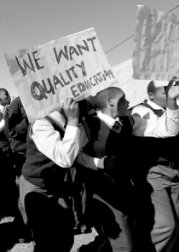 The Day of the African Child today not only serves as a commemoration but a critical annual benchmark for assessing progress, highlighting persistent challenges, and galvanising action for the continent’s youngest generation. Every year, the African Union adopts a specific theme for the Day, focusing on a pressing issue affecting African children. These themes – ranging from child labour and child marriage to access to education and the impact of climate change – compel governments, civil society organisations, international partners, and communities to engage in critical discussions, review policies, and implement programs tailored to addressing these specific challenges. It serves as a continent-wide reminder that the rights of children are non-negotiable and must be prioritised.


